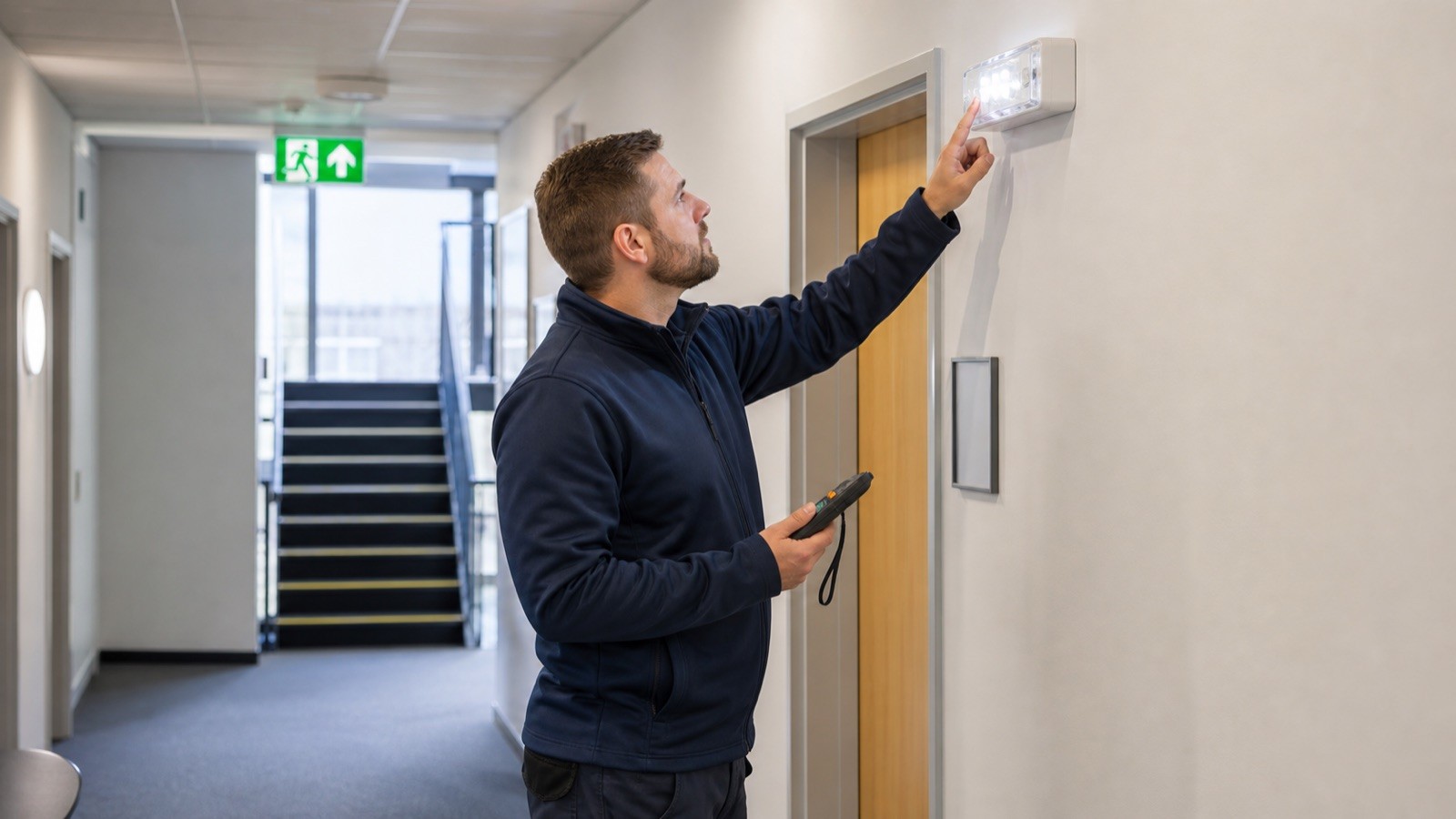





Emergency escape lighting helps people find and use escape routes when normal lighting is unavailable. For a commercial property team, maintaining it is not just a matter of pressing a test key. The system has to remain suitable for the building, operate for the required conditions and be supported by records that show checks, defects and remedial actions are being controlled.
In England, the responsible person must carry out and regularly review a fire risk assessment. Government guidance states that equipment and facilities provided for fire safety, including emergency routes, exits and associated lighting, must be maintained in effective working order. The exact arrangements should follow the building's fire risk assessment, system design, manufacturer information and the work of competent people.
This article provides a practical management framework. It is not a substitute for a fire risk assessment, emergency-lighting design or site-specific inspection.
What is emergency escape lighting for?
Emergency escape lighting is intended to support safe movement to a place of safety if normal lighting fails. Depending on the premises and fire strategy, it may help illuminate:
exit doors and escape routes;
corridor intersections and changes in direction;
stairs and changes in floor level;
final exits and external escape routes;
emergency signs;
fire alarm call points and firefighting equipment;
equipment that may need to be shut down in an emergency; and
larger, windowless or higher-risk areas identified by the assessment.
The required layout and duration depend on the premises, its occupants, escape strategy and risks. A small, simple workplace and a multi-storey public building will not necessarily require the same system.
Who is responsible for emergency lighting maintenance?
The organisation or person with fire-safety duties must ensure suitable arrangements are in place. Day-to-day checks may be assigned to a nominated person, while servicing, fault diagnosis, alterations and technical testing may require a competent contractor.
Responsibility should be documented. The maintenance process should identify who:
completes routine checks;
records tests and defects;
arranges repairs;
reviews repeated failures;
updates the fire risk assessment or fire strategy where necessary; and
confirms that remedial work is complete.
Contracting out the technical work does not remove the need for the responsible person to manage the findings and evidence.
How often should emergency lighting be checked?
The testing regime should be appropriate to the system, manufacturer instructions, applicable standards and fire risk assessment. Government fire-safety guidance for offices and shops gives examples that include:
regular visual checks where practicable;
monthly testing of emergency lighting systems to confirm adequate charge and illumination; and
annual testing and maintenance by a competent person.
These are useful management prompts, not a substitute for the building's specific requirements. Test timing should also consider the risk created while batteries recover after a discharge test.
What should a routine management check cover?
A nominated person can use an agreed checklist to look for visible problems such as:
damaged, missing or poorly secured luminaires;
warning indicators showing a fault;
obscured exit signs or changes to escape routes;
alterations, partitions or storage affecting coverage;
fittings that do not operate during the agreed functional test;
evidence of water ingress, contamination or physical damage; and
overdue defects or missing records.
The person carrying out the check should know the test method, expected indicators, reporting route and limits of their competence. Covers should not be removed and electrical repairs should not be attempted by an unauthorised person.
What should a competent maintenance visit assess?
The exact scope depends on the installation, but a competent contractor may need to review:
the available drawings, schedules and previous test records;
the condition and identification of luminaires and signs;
operation following loss of the normal lighting supply;
batteries, charging indicators and control equipment;
the agreed duration test and recovery arrangements;
local test switches or automatic testing facilities;
changes to the building layout or escape routes;
defects, limitations and inaccessible equipment; and
the priority and scope of remedial work.
The report should distinguish between a failed fitting, a maintenance issue and a wider design or coverage concern.
What records should be kept?
Government guidance recommends keeping a log book of testing and maintenance. A useful emergency-lighting record should show:
the premises and system or area tested;
the date and type of check or test;
the person or contractor completing it;
the result and any limitations;
each defect found;
the immediate action taken;
the remedial-work reference and completion date; and
any change that needs review in the fire risk assessment.
Records should be clear enough for another competent person to understand the system's recent history. Repeated failures in the same area should be investigated rather than recorded as isolated events indefinitely.
Common emergency-lighting defects
A fitting does not illuminate
The cause may relate to the luminaire, battery, charging supply, local circuit or control arrangement. The defect should be recorded and assessed; replacing a battery without confirming the cause may not resolve it.
The fitting operates but does not sustain the required test
Reduced duration can indicate battery deterioration, charging problems or another fault. The required response depends on the system and risk, but the failure should not be treated as a pass because the lamp initially illuminated.
Exit routes have changed
New partitions, racking, doors or layouts can change how people move through the premises. The fire risk assessment and emergency-lighting coverage may need review, even if every existing luminaire operates.
Indicators or test facilities are damaged
Missing indicators, inaccessible test points or damaged local switches can make routine management unreliable. The repair should restore both operation and a practical method of future testing.
Records are incomplete
Missing records do not automatically prove that the system is defective, but they make it harder to demonstrate control and identify recurring faults. Establish the current condition and restart a clear, consistent log.
How should remedial work be prioritised?
Priorities should reflect the fire risk assessment, affected escape route, occupancy, system condition and available temporary controls. A failed fitting on a critical escape route may require a different response from a documentation defect in a low-risk area.
The responsible person should agree:
whether immediate interim measures are required;
who will authorise and complete the repair;
what access or isolation is needed;
how the completed work will be tested; and
whether the fire risk assessment or drawings must be updated.
Do not invent a universal repair deadline. The competent assessment should explain the risk and recommended action for the actual premises.
When should the system be reviewed rather than repaired?
A broader review may be appropriate where:
the building layout or use has changed;
escape routes or occupancy have changed;
multiple fittings are obsolete or repeatedly failing;
testing access is impractical;
records do not match the installed system;
central equipment or controls are unreliable; or
the fire risk assessment identifies a coverage concern.
An upgrade can improve reliability and testing, but new equipment should be selected around the fire strategy and system design rather than installed as a like-for-like cosmetic replacement.
What to include in an emergency-lighting contractor brief
Provide:
the site address and type of premises;
normal working and access hours;
the current fire risk assessment information relevant to lighting;
drawings, schedules and log-book records where available;
known defects and previous remedial work;
areas with vulnerable occupants or restricted access;
the required reporting and certification format; and
the person authorised to approve remedials.
Ask the contractor to identify exclusions, inaccessible areas and any design concerns separately from routine maintenance findings.
How Azure Electrical can help
Azure Electrical supports commercial electrical inspection, maintenance and remedial work across Kent and suitable London projects. Emergency-lighting work can be coordinated with wider statutory-compliance, electrical-maintenance and remedial programmes where this is appropriate for the premises.
The agreed scope should be based on the building, available records and fire-safety requirements rather than a generic test package.
Frequently asked questions
Is a monthly function test the same as an annual duration test?
No. They serve different purposes and should be completed and recorded according to the applicable system requirements and guidance. A brief functional check does not establish that the system will operate for its required duration.
Can a facilities team test emergency lighting?
A nominated person may be able to complete defined routine checks if they are trained, authorised and understand the test method. Technical work, fault diagnosis, alterations and servicing may require a competent specialist.
Does every commercial building need the same emergency lighting?
No. The building layout, occupants, escape routes and fire risk assessment determine what is suitable. The system should be reviewed when those conditions change.
Should every failed fitting be replaced immediately?
Every failure should be recorded and assessed promptly. The responsible action and priority depend on the affected area, fire risk and available controls; a competent assessment should guide the decision.
Do emergency-lighting records matter if the fittings work?
Yes. Records support ongoing management, show what was tested, help identify repeated failures and provide evidence that defects and maintenance are being controlled.
Discuss emergency-lighting maintenance
For commercial premises in Kent or suitable London projects, provide the site type, approximate system size, known defects and available fire-safety records. Contact Azure Electrical to review the electrical requirement and help define the next practical step.